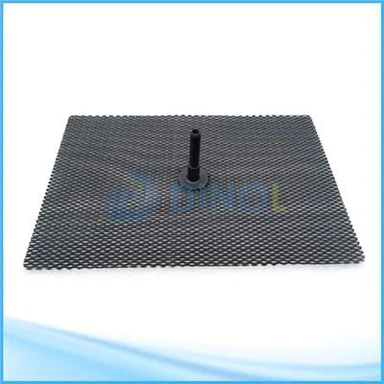
Titanium Anode for Steel Plate Galvanizing
Titanium anode can be used for steel plate galvanizing for its Low oxygen evolution overpotential, stable size and corrosion resistance.
Substrate: Titanium or Niobium
Coating: Ru-Ir, Ir-Ta, Pt, PbO2
Shape: plate, mesh, etc.
- Fast Delievery
- Quality Assurance
- 24/7 Customer Service
Product Introduction
Why Steel Strip Galvanizing Lines Are Switching to Titanium Anodes
The Real Problem in Electrogalvanizing
Electrogalvanizing is not a simple plating process. The anode must continuously evolve oxygen in a highly acidic zinc sulfate electrolyte while maintaining stable dimensions over months of operation. Traditional anodes-such as lead alloys or graphite-fail in one or more critical ways:
Lead anodes slowly dissolve, contaminating the zinc bath with lead ions. This degrades coating adhesion and creates environmental disposal problems.
Graphite anodes erode mechanically, causing carbon particles to suspend in the electrolyte and embed into the zinc coating.
Dimensionally unstable anodes change shape over time, altering the anode-cathode gap, which directly affects zinc thickness uniformity across the entire strip width.
The titanium anode solves all three problems simultaneously, which explains its growing popularity in continuous strip galvanizing lines worldwide.
How the Electrogalvanizing Process Works
Before reaching the electrolytic cells, the steel strip undergoes multiple pretreatment steps (cleaning, pickling, surface activation). The prepared cathodic strip then passes through a series of electrolyzer cells. Each cell contains an electrolyte with soluble zinc ions. Under applied current, zinc electrodeposits onto the moving steel strip surface.
Electrochemical reactions:
| Reaction site | Reaction | Product |
|---|---|---|
| Anode (titanium anode surface) | 2 H₂O → O₂↑ + 4H⁺ + 4e⁻ | Oxygen gas, hydrogen ions |
| Cathode (steel plate surface, main) | Zn²⁺ + 2e⁻ → Zn | Metallic zinc coating |
| Cathode (steel plate surface, alternative) | Sn²⁺ + 2e⁻ → Sn | Tin coating (if tin-zinc alloy is desired) |
| Cathode (undesired side reaction) | 2 H₂O + 4e⁻ → H₂↑ + 2OH⁻ | Hydrogen gas (lowers current efficiency) |
The anode reaction is oxygen evolution. This is the most demanding part of the process because oxygen evolution requires high overpotential on most materials. A good anode minimizes this overpotential to save energy.
Technical Specifications (Production Data)
| Parameter | Value / Range |
|---|---|
| Substrate material | Titanium (Ti Gr1/Gr2) or Niobium (Nb) |
| Coating types | Ru-Ir (Ruthenium-Iridium), Ir-Ta (Iridium-Tantalum), Pt (Platinum), PbO₂ (Lead Dioxide) |
| Electrode shapes | Plate, mesh, expanded mesh, or custom profiles |
| Electrolyte | Zinc sulfate or zinc chloride based solutions |
| Current density range | 1000 – 6000 A/m² (depending on line speed and coating thickness requirement) |
Four Coating Options: Selection Guide
Different coating chemistries are available depending on the specific electrolyte composition and operating conditions:
| Coating Type | Best Suited For | Key Characteristic |
|---|---|---|
| Ru-Ir | General zinc sulfate electrolytes | Low oxygen overpotential, cost-effective |
| Ir-Ta | Aggressive electrolytes, high current density | Exceptional durability, longer life |
| Platinum (Pt) | Specialty applications, high purity requirements | Inert, no coating leaching |
| PbO₂ | Low-cost alternative for less demanding lines | Economical, but contains lead |
Di Noer Technology engineers recommend the specific coating type based on the customer's actual electrolyte chemistry and target lifespan.

Advantages on a Continuous Galvanizing Line
When a galvanizing line operator installs titanium anodes (from Di Noer Technology) in place of conventional anodes, the following measurable improvements are typically observed:
1. Low oxygen evolution overpotential
The anode reaction (2H₂O → O₂↑ + 4H⁺ + 4e⁻) occurs at a significantly lower voltage compared to lead or graphite. This directly reduces tank voltage and cuts electrical energy consumption by approximately 10–18%.
2. Dimensionally stable electrode
Titanium and niobium substrates do not bend, warp, or erode unevenly. The anode-cathode gap remains constant over months of continuous operation. Stable gap = uniform zinc coating thickness across the entire strip width.
3. Excellent corrosion resistance
The anode is insoluble in zinc sulfate and zinc chloride electrolytes. No corrosion products enter the bath. This means:
No metallic contamination of the zinc coating
Longer electrolyte life (less frequent bath replacement or purification)
More reliable coating performance (corrosion resistance, paintability, weldability)
4. Light weight
Titanium density is approximately 4.5 g/cm³ (compared to lead at 11.3 g/cm³). This makes handling, installation, and maintenance significantly easier and safer. Reduced structural support requirements also lower capital costs for new lines.
5. Long service life with substrate reusability
The coated titanium anode provides extended operational life. When the coating eventually reaches end-of-life (typically after 2–5 years depending on operating severity), the titanium substrate can be stripped and recoated. The substrate material is not consumed, resulting in lower long-term anode cost.
Product Applications: Electrogalvanized Steel Plate
Electrogalvanized steel plate produced using titanium anodes offers excellent properties for downstream industries:
| Property | Benefit |
|---|---|
| Corrosion resistance | Protects automotive body panels and household appliance casings |
| Processability | Can be stamped, bent, and formed without coating damage |
| Weldability | Compatible with resistance welding and arc welding processes |
| Paintability | Zinc surface accepts primer and topcoat without adhesion failure |
Primary end-use industries:
Automotive (body panels, chassis components, fuel tanks)
Household appliances (washing machines, refrigerators, air conditioners)
Light industry (building materials, electrical enclosures, furniture)
Product Variants in Electrogalvanizing
Galvanized products are categorized by several parameters:
By coating side:
Double-sided galvanized – zinc on both surfaces
Single-sided galvanized – zinc on one surface only (for specific welding or painting requirements)
By coating thickness: Different thicknesses are produced by adjusting current density and line speed.
By post-plating treatment:
Passivated – enhances corrosion resistance
Phosphated – improves paint adhesion
Fingerprint resistant – applies an organic or inorganic film to prevent fingerprint marking during handling
Summary for Line Operators and Engineers
| Question | Answer |
|---|---|
| Why choose titanium anode for galvanizing? | Low oxygen overpotential (saves energy), stable dimensions (uniform coating), insoluble (no bath contamination) |
| Substrate options | Titanium Gr1/Gr2 or Niobium |
| Coating options | Ru-Ir, Ir-Ta, Pt, PbO₂ (selected by electrolyte and lifespan requirement) |
| Electrode shape | Plate, mesh, or custom per line design |
| Key benefit to production | Lower operating cost + consistent product quality + longer anode life |
About Di Noer Technology Co., Ltd.
Di Noer Technology provides application-specific coating recommendations based on the customer's actual electrolyte composition, current density, temperature, and expected service life. The company's titanium anodes for steel plate galvanizing are engineered to deliver reliable performance in continuous, high-volume production environments.
Hot Tags: titanium anode for steel plate galvanizing, suppliers, manufacturers, factory, customized, buy, price, quality, pricelist, in stock, for sale, Titanium Anode for PCB Electroplating, Titanium Anode for Steel Plate Tinning, Titanium Anode for Electroplating, Titanium Anode for Metal Electroplating, Titanium Anode for Steel Plate Galvanizing