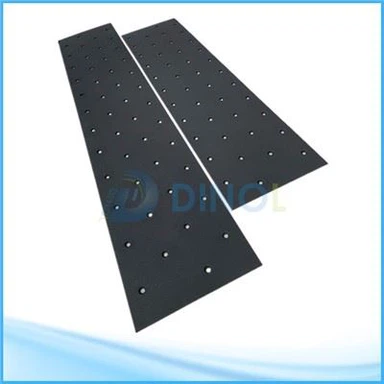
Titanium Anode for PCB Electroplating
In the traditional acid copper plating tank for printed circuit boards, the copper balls in the anode basket are continuously dissolved into Cu2+ to supplement the loss of Cu2+ deposition in the plating solution, keeping the concentration of Cu2+ in the plating solution constant. But it is...
- Fast Delievery
- Quality Assurance
- 24/7 Customer Service
Product Introduction
DSA Titanium Anode for PCB Electroplating: Replacing Soluble Anodes in Pulse Plating
The Traditional Approach and Its Limitations
In a conventional acid copper plating tank for printed circuit boards, the mechanism is straightforward. Copper balls placed in an anode basket continuously dissolve into Cu²⁺ ions. These ions replenish the copper consumed by deposition onto the PCB surface, thereby maintaining a constant Cu²⁺ concentration in the plating solution. This soluble anode system works adequately for direct current (DC) plating.
However, pulse plating introduces different characteristics and requirements. The intermittent, high-density current pulses change the mass transport dynamics near the electrode surfaces. Under these conditions, traditional soluble anodes reveal multiple shortcomings:
Non-uniform dissolution of copper balls leads to localized current distribution problems
Anode film formation interferes with pulse current transmission
Sludge and particles generated from the anode basket contaminate fine-pitch PCB features
Difficulty maintaining synchronization across multiple anodes in pulse mode
These limitations explain why more and more facilities now use DSA Titanium anode for PCB electroplating instead of conventional soluble anodes.
The DSA Solution: Insoluble Coated Titanium Anode
DSA stands for Dimensionally Stable Anode. Unlike soluble copper anodes, the DSA Titanium anode does not dissolve during electroplating. Instead, it serves as an inert surface for oxygen evolution, while copper ions are replenished independently through a separate regeneration system. This decoupling of anode function from copper supply enables precise control over pulse plating parameters.
Two System Configurations: Horizontal vs. Vertical Pulse Electroplating
PCB plating lines are configured in two main arrangements. Each places different demands on the titanium anode.
1. Insoluble Coated Titanium Anode for Horizontal Pulse Electroplating
System layout: In horizontal pulse plating lines, the insoluble anodes are installed horizontally, positioned parallel to the PCB panel as it moves through the plating bath.
Electrical connection: Each anode is directly connected to the switch of the pulse power supply using individual cables. This dedicated connection ensures that all anodes at the anode side receive identical pulse current waveforms and maintain perfect synchronization. Synchronization is critical for achieving uniform copper deposition across the entire panel surface.
Anode specification for horizontal systems:
| Parameter | Specification |
|---|---|
| Substrate | Industrial pure titanium Gr2 |
| Coating type | Ruthenium ternary mixed metal oxide coating |
| Coating characteristics | Nano-scale morphology, high surface area |
| Shape | Mesh, expanded mesh, pipe mesh |
| Function | Insoluble, oxygen-evolving anode |
The mesh structure of the titanium anode allows electrolyte to flow through the electrode, improving mass transport and reducing boundary layer thickness near the PCB cathode. This is particularly important for high-aspect-ratio through-hole plating.
2. Insoluble Coated Titanium Anode for Vertical Pulse Electroplating
System layout: Vertical plating systems using insoluble anodes are configured differently. The plating bath must be designed to handle high aspect ratio products. Standard features for high-aspect-ratio vertical plating include:
Adequate particle agitation (typically air sparging or solution jetting)
Effective filtration to remove suspended solids
Uniform current distribution across the vertical panel height
How vertical DSA systems differ from standard electroplating cells:
| Component | Standard Cell | Vertical DSA Cell |
|---|---|---|
| Anode | Soluble copper (Cu balls) | Insoluble coated titanium anode (Ru ternary or pentadic oxide) |
| Copper replenishment | From anode dissolution | Separate copper regeneration system in electrolysis cycle |
| Cathode-anode separation | None or simple shielding | Separator membrane or diaphragm installed between cathode and anode |

The Cu²⁺ accumulation challenge:
In vertical systems using insoluble anodes, a specific problem can occur: increasing Cu²⁺ concentration over time. Because the anode does not consume copper, and the cathode continues to deposit copper, the theoretical expectation is decreasing Cu²⁺. However, other reactions and regeneration systems can actually cause Cu²⁺ to rise if not properly controlled.
Solution: Copper ball regeneration column
This problem is avoided by adjusting the Cu²⁺ content using a simple copper ball regeneration column. The regeneration column contains:
Small copper balls (serving as a copper reservoir)
A diaphragm-insulated insoluble titanium anode (separate from the main plating anode)
By applying a DC potential across this regeneration column, high-concentration Cu²⁺ entering from the aqueduct is partially deposited onto the small copper balls. The plating solution exiting the column has reduced Cu²⁺ content and is returned to the main electrolytic cell. This closed-loop control prevents unwanted Cu²⁺ accumulation in the electrolyzer.
Performance advantage of vertical DSA systems:
The effect of the insoluble coated titanium anode used in vertical pulse electroplating is generally better than that achieved in horizontal systems. Under a specific thickness-to-diameter ratio (aspect ratio of PCB features), the effective dispersion rate of electroplating typically reaches 90% – 95%. This high throwing power ensures uniform copper coverage deep within small vias and through-holes, which is essential for high-reliability PCBs.
Di Noer Technology: Advanced Coating Formulations for PCB Electroplating
The Titanium Anode For PCB Electroplating developed by Di Noer Technology Co., Ltd. has undergone extensive testing and process optimization. The company's approach focuses on coating chemistry and morphology engineering.
Coating composition:
The coating formula employs ternary, pentadic (five-element), or multi-element mixed metal oxides. These complex oxide systems provide superior catalytic activity and stability compared to binary coatings.
Nano coating morphology:
The nano-scale coating morphology creates an extremely high real surface area. This large anode surface is precisely what pulse electroplating requires. Higher surface area lowers the effective current density on the anode coating, reducing oxygen evolution overpotential and extending service life.
Network structure integration:
Combined with the network (mesh) structure of the titanium substrate, the nano coating maintains both stability and uniformity across the entire electrode surface. The mesh design allows:
Bipolar current distribution (current reaches both front and back of the mesh)
Electrolyte flow-through for reduced concentration polarization
Mechanical flexibility to accommodate thermal expansion
Adhesion and durability:
Through continuous improvement in anode production and processing technology, the coating achieves strong adhesion with the titanium Gr2 substrate. Key performance outcomes:
| Property | Benefit |
|---|---|
| High current tolerance | Operates reliably under pulse current peaks |
| Long service life | Extended replacement intervals |
| No plating solution contamination | Inert coating, no dissolution products |
| Avoids frequent replacement | Reduced maintenance downtime |
| Labor and material cost savings | Lower total cost of ownership |
Summary: Why PCB Platers Choose DSA Titanium Anodes
| Traditional Soluble Anode | DSA Titanium Anode (Di Noer) |
|---|---|
| Copper balls dissolve unevenly | No dissolution, stable dimensions |
| Sludge and particles contaminate bath | Inert coating, clean operation |
| Difficult pulse current synchronization | Direct cable connection to each anode |
| Cu²⁺ concentration drifts | Controlled via regeneration column |
| Frequent basket maintenance required | Long service life, minimal maintenance |
| Lower throwing power in high-aspect-ratio features | 90–95% dispersion rate (vertical systems) |
The transition from soluble copper anodes to DSA Titanium anode for PCB electroplating is now well-established in advanced PCB manufacturing. Facilities requiring fine-pitch features, high-aspect-ratio vias, and pulse plating capability increasingly specify ruthenium ternary or multi-element mixed metal oxide coatings on titanium Gr2 mesh substrates.
Di Noer Technology Co., Ltd. provides application engineering support to match coating formulation (ternary, pentadic, or multi-element) with specific pulse parameters, bath chemistry, and production requirements.
Hot Tags: titanium anode for pcb electroplating, suppliers, manufacturers, factory, customized, buy, price, quality, pricelist, in stock, for sale, Titanium Anode for PCB Electroplating, Titanium Anode for Steel Plate Galvanizing, Titanium Anode for Electroplating, Titanium Anode for Steel Plate Tinning, Titanium Anode for Metal Electroplating