

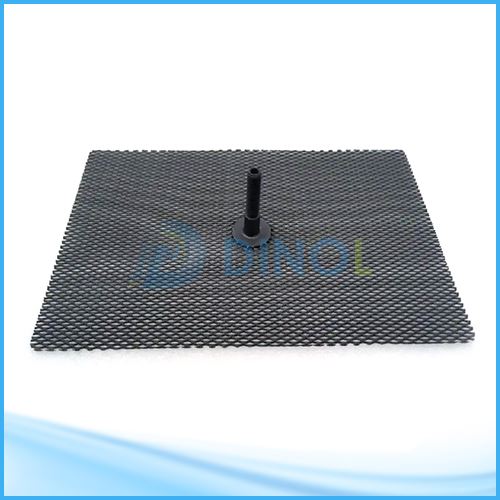
Titanium Anode for Electrodialysis
1.Coating: Ruthenium or Iridium or Platinum
2.Substrate Titanium Gr1 or Gr2
3.Size: 100-3000mm
4.Design Life: 1-10 years
- Fast Delievery
- Quality Assurance
- 24/7 Customer Service
Product Introduction
Titanium Anode for Electrodialysis & EDI Water Treatment | Product Technical Manual
1. Product Overview & Working Principle
Electrodialysis (ED/EDR) and Continuous Electrodeionization (EDI) are mainstream electrochemical separation and water purification technologies widely used in industrial water treatment, desalination and material concentration. Under external DC electric field, cation and anion exchange membranes perform selective ion permeation: cations migrate toward the cathode through cation membranes, while anions move toward the anode through anion membranes. This targeted ion migration realizes efficient separation, concentration and purification of water bodies and ionic pollutants.
As one of the core components of electrodialysis desalination equipment, electrodes determine the operational stability, energy consumption and service life of the entire system. Frequent polarity reversal is a typical working condition of electrodialysis equipment, which requires electrodes to withstand both oxidation and reduction reactions stably for bidirectional operation. Traditional electrodes struggle to adapt to this harsh alternating working environment.
Our titanium-based noble metal oxide coated anodes are professionally developed for electrodialysis and EDI systems. Featuring excellent anti-oxidation and anti-reduction performance, low chlorine evolution overpotential and outstanding electrocatalytic activity, they perfectly adapt to frequent polarity reversal operation, solving the corrosion and short-life pain points of traditional graphite and common metal electrodes.
Product Specifications & Forms
Product Types: Plate type, mesh type and customized special shapes
Core Features: Polarity reversal resistant, low power consumption, corrosion resistant, long service life
Applicable Systems: ED, EDR, EDI ultrapure water equipment and industrial electrodialysis reactors

2. Application Scenarios
Our electrodialysis titanium anodes are widely adopted in high-precision water treatment and industrial resource recovery scenarios, covering civil desalination and industrial wastewater treatment fields:
EDI Ultrapure Water Preparation: Ideal for semiconductor, electronic manufacturing, pharmaceutical and power industries. It supports stable production of high-purity water with resistivity up to 18.2 MΩ·cm, meeting the strict water quality requirements for chip production, pharmaceutical preparation and boiler feed water.
Industrial High-Salt Wastewater Treatment & Resource Concentration: Applied in electrodialysis reactors for desalination, concentration and resource recovery of high-salt wastewater from chemical, printing and dyeing, and pharmaceutical industries, realizing wastewater reduction and resource recycling.
Seawater & Brackish Water Desalination: Suitable for offshore platforms, coastal industrial parks and remote areas. It efficiently removes salt ions from raw water, reducing the operating pressure and cost of subsequent water treatment processes.
Industrial Electrodialysis Purification & Separation: Used for material desalination, solution purification and ionic impurity removal in fine chemical and food processing industries, ensuring stable and efficient separation of ionic pollutants.
3. Core Product Advantages
Different from ordinary industrial electrodes, our customized titanium anodes for electrodialysis are optimized for frequent polarity reversal and long-term continuous operation, with unique practical advantages in actual engineering applications:
Excellent Polarity Reversal Resistance: The titanium substrate paired with noble metal oxide coating withstands alternating oxidation and reduction working conditions. It maintains stable performance during frequent electric field switching, without corrosion, dissolution or structural deformation, fully meeting the core operation requirements of ED/EDR/EDI systems.
Low Overpotential & Energy Saving: The product has ultra-low chlorine evolution overpotential and excellent electrocatalytic activity. It ensures uniform current distribution in the electrolytic system, effectively reducing cell voltage and overall power consumption, bringing long-term energy-saving benefits for continuous operation equipment.
No Secondary Pollution & Stable Water Quality: As an insoluble anode, it will not produce electrode sludge or metal dissolution during operation. It avoids raw water and solution pollution, ensuring stable and qualified effluent water quality for high-precision water treatment scenarios.
Long Service Life & Low Maintenance Cost: It solves the defect of severe corrosion and rapid aging of traditional electrodes under polarity reversal conditions. It supports 24/7 long-term continuous operation, greatly reducing equipment shutdown frequency and electrode replacement cost.
High Customization Compatibility: Multiple shapes including plates and meshes are available, with customizable sizes and coating formulas. It can perfectly match different specifications of electrodialysis modules and EDI equipment, adapting to diverse industrial working conditions.
4. Comparative Analysis: Titanium Anode vs. Traditional Electrodes
Traditional electrodialysis equipment mostly uses graphite electrodes and ordinary metal electrodes, which cannot adapt to frequent polarity reversal working conditions and have obvious limitations in industrial applications. The detailed performance comparison is as follows:
|
Comparison Item |
Traditional Graphite Electrode |
Our Titanium Electrodialysis Anode |
|---|---|---|
|
Polarity Reversal Adaptability |
Poor resistance, severe corrosion and peeling under alternating oxidation-reduction conditions |
Fully adaptable to frequent polarity reversal, stable bidirectional operation |
|
Operational Stability |
Unstable current output, easy to cause water quality fluctuation |
Uniform current distribution, stable electrocatalytic performance with low attenuation |
|
Energy Consumption |
High overpotential, large cell voltage and high power consumption |
Low chlorine evolution overpotential, significant energy saving effect |
|
Service Life |
Short service life, frequent replacement required |
Long service life, suitable for long-term continuous operation |
|
Pollution Risk |
Easy to produce peeling slag, causing secondary pollution to water body |
Insoluble and sludge-free, ensuring clean water quality |
|
Comprehensive Cost |
Low initial cost but high frequent maintenance and replacement cost |
Optimal full-cycle cost, saving labor and downtime loss |

5. Practical Customer Application Cases
Our electrodialysis titanium anodes have been widely applied in industrial water treatment and ultrapure water projects, delivering stable performance and tangible economic benefits for customers:
Semiconductor EDI Ultrapure Water Project: For a large electronic manufacturing enterprise, customized mesh-type titanium anodes were adopted for EDI ultrapure water equipment. After 3 years of continuous operation, the equipment ran stably without electrode corrosion or performance attenuation. The effluent resistivity remained stable above 17.8 MΩ·cm, fully meeting the production standards of chip packaging and testing, and reducing the annual equipment maintenance cost by 25%.
Chemical High-Salt Wastewater Concentration Project: Serving a fine chemical enterprise's electrodialysis wastewater treatment system, our polarity-reversal-resistant titanium anodes solved the problem of rapid aging and failure of traditional graphite electrodes in high-salt and alternating electric field environments. The continuous operation stability of the wastewater treatment line was significantly improved, and the system downtime caused by electrode failure was reduced by 80%.
Coastal Brackish Water Desalination Project: For industrial park brackish water desalination and domestic water purification projects, our plate-type titanium anodes matched large-scale electrodialysis equipment stably. They effectively reduced the energy consumption of the desalination system, improved water production efficiency, and realized long-term stable and low-cost operation of the water treatment system.
6. Frequently Asked Questions (FAQ)
Q1: Why are ordinary graphite electrodes not suitable for electrodialysis polarity reversal working conditions?
A: Electrodialysis systems require frequent positive and negative pole switching, which produces alternating oxidation and reduction reactions on the electrode surface. Graphite electrodes have poor resistance to alternating corrosion, prone to surface peeling, structural damage and rapid performance decay, resulting in water body pollution and system shutdown. Our titanium coated anodes are professionally optimized for polarity reversal scenarios to avoid all these problems.
Q2: What are the core advantages of titanium anodes in EDI ultrapure water systems?
A: They feature zero sludge generation and no metal dissolution, which avoids secondary pollution to ultrapure water and guarantees high water purity. Meanwhile, low overpotential reduces system power consumption, and long-term stable performance lowers the failure rate of EDI modules, ensuring continuous and stable water supply for high-precision production.
Q3: Can you provide customized anode shapes and specifications?
A: Yes. We support customized production of plate, mesh and special-shaped titanium anodes. According to customers' electrodialysis equipment size, current parameters and working condition characteristics, we can design exclusive anode specifications and coating schemes to achieve the best matching and operational effect.
Q4: What working conditions are electrodialysis titanium anodes suitable for?
A: They are widely applicable to ED/EDR electrodialysis systems, EDI ultrapure water equipment, seawater and brackish water desalination, industrial high-salt wastewater treatment and material concentration and purification scenarios, especially suitable for equipment with frequent polarity reversal and long-term continuous operation.
Q5: How long is the service life of electrodialysis titanium anodes?
A: The service life depends on actual current density, water quality environment and operating frequency. Under standard industrial working conditions, the product maintains stable performance for a long time, with far longer service life than traditional graphite electrodes, effectively reducing long-term operating and maintenance costs for customers.
Hot Tags: titanium anode for electrodialysis, suppliers, manufacturers, factory, customized, buy, price, quality, pricelist, in stock, for sale, MMO Tubular Pipe Network, PbO2 Titanium Anode for Wastewater Treatment, Titanium Anode For Water Treatment Plant, Titanium Mesh Anode for Water Treatment, Titanium Anode for Water Treatment, Titanium Anode Basket for Water Treatment
No Information


