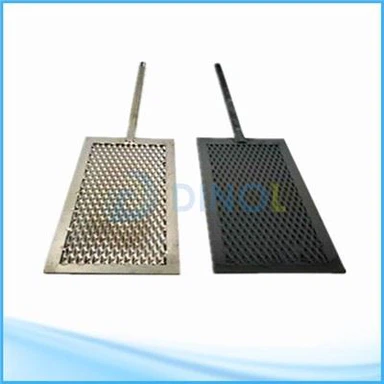
Titanium Anode for Aluminum Foil Formation
Titanium Anode For Aluminum Foil Formation is used to make foil formation. Its formation is that after electrochemical or chemical corrosion of high purity (more than 99.9%), the surface is treated into spongy / tunnel structure to increase its surface area, and then the electrolytic foil is...
- Fast Delievery
- Quality Assurance
- 24/7 Customer Service
Product Introduction
Titanium Anode for Aluminum Foil Formation
Product Overview
Titanium Anode for Aluminum Foil Formation is a specialized electrode used in the production process of aluminum electrolytic capacitor foil. The aluminum foil used for capacitor manufacturing first undergoes electrochemical or chemical corrosion of high-purity aluminum (purity ≥ 99.9%), creating a spongy or tunnel-structured surface to significantly increase its specific surface area. Thereafter, the etched foil is anodized in a forming solution to grow a dense, uniform aluminum oxide (Al₂O₃) film on the surface. This oxide layer serves as the dielectric in aluminum electrolytic capacitors. The titanium anode acts as the counter electrode during this anodizing (forming) process.
Classification of Formed Aluminum Foil
Formed aluminum foil is generally categorized into four types based on the applied voltage range:
| Type | Voltage Range |
|---|---|
| Extremely low voltage | < 16V |
| Low voltage | 16V – 100V |
| Medium high voltage | 100V – 450V |
| High voltage | > 450V (up to 800V) |
Foil thickness ranges from 25 to 110 microns. Thinner foils are typically used for low voltage applications, while thicker foils are required for high voltage applications to withstand higher breakdown fields.
Classification by purpose:
Positive foil (Anode foil / Formed foil): The foil that has been anodized to form an aluminum oxide dielectric layer. Thickness ranges from 0.03 to 0.12 mm, with withstand voltage from 8V to 800V.
Negative foil (Cathode foil): Unformed or lightly formed foil used as the cathode electrode.
Guide foil (Tab foil): Used for internal connections within the capacitor.
In a typical aluminum electrolytic capacitor construction, the anode foil and cathode foil are wound together with separator paper, impregnated with electrolyte, and housed in a can. The titanium anode described here is used during the manufacturing of the anode foil, not within the final capacitor.
Technical Specifications (Real Data)
| Parameter | Value / Range |
|---|---|
| Substrate material | Titanium Gr1 (Grade 1) |
| Coating type | Iridium-Tantalum based mixed metal oxide (MMO) |
| Anode shape | Generally plate shape (custom sizes available) |
| Current density | < 1500 A/m² |
| Feed solution (electrolyte) systems | Ammonium adipate, ammonium citrate, phosphoric acid, and other solution systems |
| Warranty period | Minimum 18 months (when operated under recommended conditions) |
Advantages of Di Noer Technology's Titanium Anode for Aluminum Foil Formation
Stable dimensional accuracy
The titanium anode plate maintains excellent dimensional stability. The electrode spacing does not change during electrolysis, ensuring consistent electrolysis operation under stable cell voltage. This is critical for producing uniform aluminum oxide film thickness across the entire foil width.
Lower working voltage and reduced power consumption
Compared to conventional lead or other anode materials, the titanium MMO anode operates at a lower cell voltage under the same current density. This results in approximately 20% reduction in power consumption, leading to significant energy savings over the lifetime of the electrode.
Extended service life
The iridium-tantalum coating provides excellent stability under anodizing conditions. The anode offers a long operational lifetime with minimal coating degradation, reducing production downtime for electrode replacement.
Insoluble anode characteristics
Unlike soluble anodes (e.g., lead or aluminum anodes), the titanium anode is insoluble in the forming electrolyte. This avoids contamination of the electrolyte and prevents deposition of corrosion products onto the cathode foil, thereby improving product purity and electrical properties of the finished aluminum foil.
Higher current density capability
The MMO coating allows operation at higher current densities without excessive voltage rise or rapid coating deterioration. This enables faster production rates and higher throughput in aluminum foil forming lines.
Strong corrosion resistance
Titanium substrates with iridium-tantalum coatings exhibit excellent resistance to corrosion in a wide range of aggressive electrolytic media, including organic acid salt solutions (adipate, citrate, phosphate) over a broad pH range and temperature range. This makes them suitable for special requirements where other anode materials fail.
No short-circuit issues
Conventional lead anodes can deform under electrolysis conditions, leading to uneven electrode spacing, local current concentration, and short-circuit problems. The rigid titanium anode maintains its shape, eliminating deformation-related short circuits and improving overall current efficiency.
Titanium substrate reusability
When the MMO coating eventually reaches the end of its service life, the coating can be stripped away, and the titanium substrate can be re-pretreated and recoated. This reusability significantly reduces long-term capital costs and supports sustainable manufacturing practices.

Anode Type and Customization
Standard anode type: Iridium-Tantalum coated MMO (Mixed Metal Oxide) anode, generally supplied in plate shape. The titanium plate thickness, width, length, and hole patterns can all be customized according to the specific design requirements of the customer's foil forming machine.
Custom coating formulations: Di Noer Technology Co., Ltd. can design corresponding coating formulations for customers based on their specific electrolyte composition, operating current density, temperature, and desired anode lifespan. Each formulation is optimized to achieve the stated warranty period of at least 18 months under normal operating conditions.
Process Integration
In a typical aluminum foil forming line, multiple titanium anodes and aluminum foil (cathode) are arranged alternately in a forming bath containing the feed solution. The foil passes through the bath continuously while a DC current is applied between the titanium anodes (positive) and the aluminum foil (negative). This anodizes the foil surface, growing aluminum oxide to a target thickness determined by the forming voltage. The stable performance of the titanium anode directly contributes to consistent oxide thickness, capacitance, and breakdown voltage of the final product.
Summary
The Titanium Anode for Aluminum Foil Formation from Di Noer Technology Co., Ltd. offers a combination of dimensional stability, energy efficiency, long life, and corrosion resistance that is superior to conventional anode materials. With real, validated specifications (current density <1500 A/m², minimum 18-month warranty, compatibility with adipate/citrate/phosphate systems), these anodes are engineered to meet the demanding requirements of modern aluminum electrolytic capacitor foil production. The ability to reuse the titanium substrate and customize the coating formulation provides both economic and technical advantages to foil manufacturers.
Hot Tags: titanium anode for aluminum foil formation, suppliers, manufacturers, factory, customized, buy, price, quality, pricelist, in stock, for sale, Titanium Anode for Chlor Alkali Industry, Titanium Anode for Aluminum Foil Formation, Titanium Anode Applications