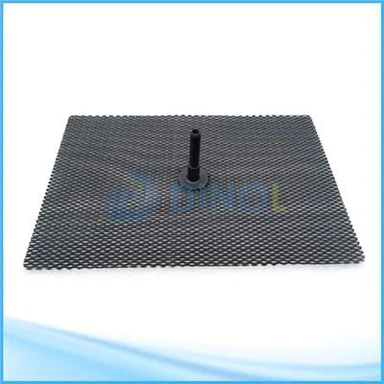
Titanium-Based Lead Dioxide Anode
1.Substrate: Titanium Gr1 or Gr2
2.Coating: Titanium-based lead dioxide anode
3.Coating Thickness: 8~20μm
- Fast Delievery
- Quality Assurance
- 24/7 Customer Service
Product Introduction
Titanium-Based Lead Dioxide Anode – High Performance for Harsh Electrochemical Environments
What Is a Titanium-Based Lead Dioxide Anode?
A titanium-based lead dioxide anode is an insoluble electrode consisting of a titanium substrate coated with a layer of lead dioxide (PbO₂) . This combination delivers the mechanical strength and corrosion resistance of titanium with the excellent electrochemical properties of lead dioxide.
These anodes are widely used in applications where conventional anode materials fail due to aggressive electrolytes or demanding operating conditions.
Why Lead Dioxide as a Coating Material?
Lead dioxide has several properties that make it attractive for electrochemical applications:
| Property | Advantage |
|---|---|
| High oxygen overpotential | Efficient oxygen evolution |
| Excellent electrical conductivity | Low energy loss |
| Good chemical stability | Resists attack in many electrolytes |
| Low material cost | Economical compared to precious metals |
| Hard and durable surface | Withstands mechanical stress |
However, pure lead dioxide anodes are mechanically weak. By bonding PbO₂ to a titanium substrate, the anode gains structural strength while keeping the beneficial surface properties.
Key Applications
Titanium-based lead dioxide anodes are commonly used in:
Electrowinning of non-ferrous metals – Zinc, copper, nickel, cobalt
Chrome plating – As an auxiliary anode for complex shapes
Electrochemical wastewater treatment – Degradation of organic pollutants
Ozone generation – High-efficiency ozone production
Perchlorate and chlorate production
Cathodic protection systems
Organic electrosynthesis
Technical Parameters
| Parameter | Specification |
|---|---|
| Substrate material | Titanium Grade 1 or Grade 2 |
| Intermediate layer | Mixed metal oxide (bonding layer) |
| Surface coating | Lead dioxide (PbO₂) |
| Coating thickness | 10 – 100 μm (customizable) |
| Oxygen evolution potential | 1.8 – 2.0 V (vs. SCE) |
| Operating current density | 100 – 2,000 A/m² |
| Operating temperature | < 60°C (standard), higher with customization |
| Operating pH range | 0 – 10 |
| Available shapes | Plate, mesh, rod, tube, custom profiles |
How Titanium-Based Lead Dioxide Anodes Compare
| Property | Lead Alloy Anode | Graphite Anode | Titanium-Based PbO₂ Anode |
|---|---|---|---|
| Dimensional stability | Poor (corrodes) | Fair (erodes) | Excellent |
| Service life | Short | Moderate | Long |
| Contamination risk | High (lead ions) | Low (carbon particles) | Low (stable coating) |
| Current efficiency | Moderate | Low | High |
| Mechanical strength | Moderate | Brittle | High |
| Cost | Low | Low | Moderate |
The Role of the Titanium Substrate
The titanium substrate provides several critical functions:
Structural support – Titanium Grade 1 or 2 offers excellent strength without brittleness
Corrosion barrier – Titanium's native oxide layer protects against electrolyte attack
Current distribution – Uniform conductivity across the entire electrode surface
Dimensional stability – No warping or deformation under normal operation
The Intermediate Layer – Why It Matters
Direct coating of lead dioxide onto titanium does not work well. The natural oxide layer on titanium prevents proper adhesion. Di Noer applies a mixed metal oxide intermediate layer between the titanium substrate and the PbO₂ coating. This layer:
Bonds strongly to both titanium and lead dioxide
Prevents passivation of the titanium surface
Extends the working life of the anode
Maintains stable electrical contact
Coating Thickness Selection Guide
| Thickness Range | Typical Application | Expected Life |
|---|---|---|
| 10 – 30 μm | Light-duty, intermittent use | 6 – 12 months |
| 30 – 50 μm | General industrial use | 1 – 2 years |
| 50 – 80 μm | Heavy-duty continuous operation | 2 – 3 years |
| 80 – 100 μm | Extreme conditions, maximum life | 3 – 5+ years |
Operating Conditions and Limitations
Temperature
Standard titanium-based lead dioxide anodes operate reliably below 60°C. Above this temperature, the coating may degrade more quickly. For higher temperature applications, Di Noer offers modified coating formulations – please consult our technical team.
pH Range
The standard operating pH range is 0 to 10. Strongly alkaline conditions (pH > 10) are not recommended for standard PbO₂ anodes.
Current Density
Normal operating range: 100 – 2,000 A/m². Higher current densities are possible but may reduce service life.
Shape and Form Options
Di Noer manufactures titanium-based lead dioxide anodes in various configurations:
| Shape | Typical Use |
|---|---|
| Plate | Flat electrodes for tank plating |
| Mesh | High surface area, good electrolyte flow |
| Rod | Deep tanks, auxiliary anodes |
| Tube | Cylindrical cell configurations |
| Custom profile | Specialized cell geometries |
Advantages of Di Noer Titanium-Based Lead Dioxide Anodes
Long Service Life
Compared to traditional lead alloy anodes, the titanium-based version lasts significantly longer due to the stable substrate and strong coating adhesion.
No Lead Contamination
The PbO₂ coating is stable and does not dissolve into the electrolyte under normal operating conditions. This is especially important for metal electrowinning where product purity matters.
High Current Efficiency
The high oxygen overpotential of lead dioxide means less energy wasted on side reactions. More of the applied current goes to the desired electrochemical reaction.
Dimensional Stability
Unlike lead alloy anodes that gradually corrode and change shape, titanium-based PbO₂ anodes maintain their original dimensions throughout their service life.
Cost-Effective
While more expensive than lead alloy anodes initially, the longer service life and better performance often result in lower total cost of ownership.
Quality Control Measures
Each titanium-based lead dioxide anode produced by Di Noer undergoes:
Substrate inspection – Confirms Grade 1 or 2 titanium with proper surface preparation
Coating thickness measurement – Verifies specified PbO₂ thickness
Adhesion testing – Ensures the coating bonds correctly to the intermediate layer
Electrical conductivity check – Confirms uniform current distribution
Visual inspection – No cracks, voids, or exposed substrate areas

FAQ – Titanium-Based Lead Dioxide Anode
1. How does a lead dioxide anode compare to a platinum anode?
Platinum anodes offer superior performance but at a very high cost. Lead dioxide anodes provide excellent performance for oxygen evolution applications at a fraction of the cost of platinum. For most industrial applications (electrowinning, wastewater treatment), PbO₂ is the more economical choice.
2. Is this anode safe for use in drinking water or food applications?
No. Lead dioxide contains lead. While the coating is stable under normal conditions, any damage or improper operation could potentially release lead ions. Do not use PbO₂ anodes in applications involving drinking water, food processing, or pharmaceutical production.
3. Why does the anode need an intermediate layer between titanium and PbO₂?
Without an intermediate layer, the natural oxide film on titanium prevents the lead dioxide from bonding properly. The intermediate layer (mixed metal oxide) adheres strongly to both materials, creating a durable, long-lasting electrode.
4. What causes a lead dioxide anode to fail?
Common failure modes include:
Coating delamination – Poor adhesion, often due to improper substrate preparation
Substrate passivation – Titanium oxide layer grows too thick, increasing resistance
Mechanical damage – Physical impact cracks the coating
Overheating – Extended operation above 60°C accelerates degradation
5. Can I operate this anode in reverse polarity?
No. Titanium-based lead dioxide anodes are designed for use as anodes only. Reversing polarity will damage the coating and may destroy the anode.
6. How do I clean a lead dioxide anode?
Rinse with deionized water after use. For accumulated scale or deposits, a mild acid dip (e.g., dilute sulfuric acid) may be used. Avoid mechanical cleaning methods that could scratch or chip the PbO₂ surface.
7. Is this anode suitable for seawater applications?
Generally no. Chloride-rich environments like seawater can cause the lead dioxide coating to degrade more rapidly. For seawater or brine applications, ruthenium-based anodes (chlorine evolution type) are a better choice.
8. What is the typical lead content of this anode?
The lead is present only in the PbO₂ surface coating. Total lead content is very low compared to solid lead or lead alloy anodes. However, proper disposal procedures for lead-containing materials should still be followed at end of life.
9. Can you make custom shapes for a specific electrolysis cell?
Yes. Di Noer offers custom shapes including plates with cutouts, curved surfaces, and special mounting features. Please provide drawings or a detailed description of your cell geometry.
10. How should I store a titanium-based lead dioxide anode before use?
Store in a clean, dry location at room temperature. Avoid contact with strong reducing agents, high humidity, or physical impacts. No special packaging is required for short-term storage.
Why Choose Di Noer for Titanium-Based Lead Dioxide Anodes?
Proper layered structure – Intermediate layer ensures strong PbO₂ adhesion
Thickness options – 10 to 100 μm coating thickness
Shape flexibility – Plate, mesh, rod, tube, or custom profiles
Quality assured – Each anode inspected before shipment
Application expertise – Years of experience in electrowinning and wastewater treatment
Technical support – Help with selection, installation, and troubleshooting
Contact Di Noer
If you need a titanium-based lead dioxide anode for electrowinning, chrome plating, wastewater treatment, or any other electrochemical application, please contact Di Noer Company.
Provide your operating parameters (electrolyte composition, temperature, current density, desired shape) and we will recommend the appropriate coating thickness and configuration.
Di Noer – Titanium-based lead dioxide anodes for demanding industrial electrochemistry.
Hot Tags: titanium-based lead dioxide anode, suppliers, manufacturers, factory, customized, buy, price, quality, pricelist, in stock, for sale, Titanium Anode for Water Treatment, V shaped MMO Board, MMO Plate Anode for Water Treatment, Titanium Anode for Electrodialysis, MMO Tubular Pipe Network, Titanium Anode Basket for Water Treatment