Low Voltage And Long-life Titanium Anodes Have Shown Great Application Value And Prospects in The Fields Of Electrochemistry And Environmental Protection.
Mar 04, 2025
1. Overview of Titanium Anode Products
1.1 Definition and Composition
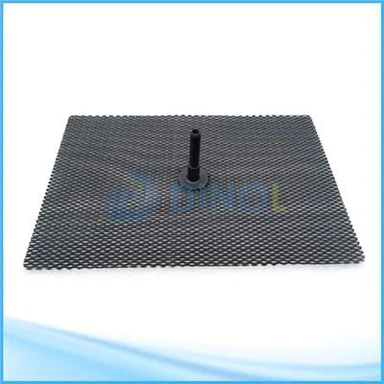
Titanium anode https://dinoer-anodes.com is an electrode material based on titanium and coated with precious metal oxide on its surface, widely used in the field of electrochemistry. Its core components include a titanium substrate and a precious metal oxide coating. The titanium substrate has characteristics such as high strength, low density, and corrosion resistance, providing strong support for the anode; The precious metal oxide coating endows the titanium anode with excellent electrocatalytic performance and conductivity, while significantly improving its durability in harsh environments.
2. Analysis of core advantages
2.1 Low voltage characteristics
The low voltage characteristic is one of the key advantages of titanium anodes in electrochemical applications, mainly due to their excellent conductivity and electrochemical stability. In the electrolysis process, voltage is the key factor determining energy consumption, and titanium anodes can achieve efficient electrolysis reactions at lower voltages, thereby significantly reducing energy consumption.
Energy consumption comparison: In the chlor alkali industry, the working voltage of traditional graphite anodes is usually between 3.5-4.0 volts, while the working voltage of titanium anodes can be reduced to around 3.0 volts. This means that under the same electrolysis conditions, titanium anodes can save up to 15% -20% of electricity consumption.
Efficiency improvement: In the field of hydrogen production through electrolysis of water, the low voltage characteristics of titanium anodes enable them to achieve higher hydrogen production efficiency with lower energy consumption. Research has shown that electrolytic cells using titanium anodes can achieve efficient hydrogen production from water electrolysis at a voltage of 1.8 volts, while traditional electrode materials typically require voltages above 2.0 volts.
Economic benefits: Taking a medium-sized electrolysis water hydrogen production plant as an example, the annual electricity consumption is about 10 million kilowatt hours. After using titanium anodes, if 15% of electricity consumption can be saved, approximately 1.5 million kilowatt hours of electricity can be saved annually. Calculated at a price of 0.5 yuan per kilowatt hour, approximately 750000 yuan in operating costs can be saved annually.

Environmental benefits: The low voltage characteristic not only reduces energy consumption, but also reduces carbon emissions caused by electricity production. Calculated based on saving 1.5 million kilowatt hours of electricity annually, it is equivalent to reducing approximately 1200 tons of carbon dioxide emissions, which is of great significance for achieving green and sustainable development.
2.2 Long life characteristics
The long lifespan of titanium anodes https://dinoer-anodes.com is another important advantage that is highly favored in industrial applications. The precious metal oxide coating on its surface (such as ruthenium, iridium, etc.) not only has excellent electrocatalytic activity, but also effectively resists corrosion and passivation, allowing the titanium anode to maintain stable performance in harsh working environments.
Comparison of service life: In the production of chlor alkali industry by diaphragm method, the traditional graphite anode has a service life of only about 8 months, while the service life of titanium anode can reach more than 6 years. This means that using titanium anodes can reduce the frequency of anode replacement by more than 7 times within the same production cycle.
Maintenance cost reduction: In the electroplating industry, electroplating solutions usually have strong corrosiveness, and ordinary electrode materials are prone to failure due to corrosion, requiring frequent replacement. And titanium anodes can work stably in highly corrosive environments for several years, greatly reducing the frequency of equipment maintenance and replacement. According to statistics, the use of titanium anodes can reduce the annual electrode replacement cost for electroplating companies by about 80%.
Improved production stability: The long-life characteristic enables titanium anodes to maintain stable performance during long-term operation, reducing production interruptions caused by electrode replacement. In chlor alkali production, the use of titanium anodes significantly improves the stability of the production process, stabilizes product quality, and reduces the defect rate by about 10%.
Economic and environmental benefits: The long-life characteristic not only reduces the maintenance and replacement costs of equipment for enterprises, but also reduces the waste generated by frequent electrode replacement. Taking a medium-sized chlor alkali plant as an example, the annual waste generated by electrode replacement is about 5 tons. After using titanium anodes, this number can be reduced to less than 1 ton, which not only reduces the waste disposal cost of the enterprise, but also reduces environmental pollution.
3. Technological Innovation and Development
3.1 Coating process improvement
The continuous improvement of coating technology is one of the key factors for enhancing the performance of titanium anodes. In recent years, the performance of precious metal oxide coatings has been significantly optimized through the use of advanced nanotechnology.
Nano coating technology: Nano level precious metal oxide coatings can significantly enhance the electrocatalytic activity of titanium anodes. Compared with traditional micron level coatings, nano coatings have a larger specific surface area and more active sites, thereby improving the reaction efficiency of the electrode. For example, in the application of electrolyzing seawater to produce chlorine, the use of nano coated titanium anodes can achieve higher chlorine gas production at lower voltages, with a voltage reduction of about 0.2 volts.
Multi layer composite coating design: The multi-layer composite coating further enhances the corrosion resistance and service life of the titanium anode by sequentially coating different functional precious metal oxide layers on the surface of the titanium substrate. Research has shown that the service life of titanium anodes with multi-layer composite coatings can be extended by 30% -50% in strong acid and alkali environments. For example, in the electroplating industry, the service life of multi-layer composite coated titanium anodes can reach 1.5 times that of traditional single-layer coated anodes.
Coating uniformity improvement: By improving the coating process, the uniform distribution of precious metal oxide coating on the surface of titanium substrate is ensured, further improving the performance consistency of titanium anode. Advanced coating technology can control the uniformity of coating thickness within ± 5%, which not only improves the conductivity and electrocatalytic performance of the electrode, but also reduces local corrosion problems caused by uneven coating.
3.2 Intelligent Manufacturing Applications
The application of intelligent manufacturing technology has brought new breakthroughs to the production of titanium anodes, further improving the performance and quality of products.
Accurate control of coating parameters: Intelligent manufacturing systems can precisely control the thickness, uniformity, and composition distribution of coatings. Real time monitoring of various parameters during the coating process through automated equipment and sensor networks to ensure consistency in coating quality. For example, in the production process, intelligent systems can control the error of coating thickness within ± 0.01 microns, significantly improving the performance stability of titanium anodes.
Quality inspection and feedback mechanism: Intelligent manufacturing introduces advanced quality inspection equipment and real-time feedback mechanism. During the production process, the performance of titanium anodes is monitored in real-time through optical inspection, electrochemical testing, and other methods. Once an anomaly is detected, the system can immediately adjust production parameters to ensure product quality. This feedback mechanism not only improves the product qualification rate, but also shortens the production cycle and enhances production efficiency.
Customized production: Intelligent manufacturing technology makes customized production of titanium anodes possible. According to the needs of different customers, enterprises can quickly adjust coating formulas and process parameters to produce titanium anode products that meet specific application scenarios. For example, in the water treatment industry, companies can customize titanium anodes with different electrocatalytic activity and corrosion resistance to meet different water quality and treatment requirements, thereby enhancing the market competitiveness of their products.
Data driven optimization: By collecting and analyzing a large amount of data during the production process, enterprises can continuously optimize coating processes and production workflows. Data driven optimization not only improves product performance, but also reduces production costs. For example, through the analysis of historical production data, enterprises have found that optimizing the sintering temperature of coatings can improve the adhesion and durability of coatings, thereby adjusting process parameters and further improving product quality https://dinoer-anodes.com
4. Expansion of application areas
4.1 Application in the Water Treatment Industry
Titanium anodes are widely used in the water treatment industry and have significant advantages. Their low voltage and long lifespan make them an ideal choice in this field.
Sodium hypochlorite production: In sodium hypochlorite electrolysis cells, the low voltage characteristics of titanium anodes can significantly reduce energy consumption. Traditional electrode materials require high voltage in the production process, while titanium anodes can efficiently electrolyze saltwater to generate sodium hypochlorite disinfectant at voltages as low as 2.5 volts. Compared with traditional electrodes, titanium anodes can save up to 20% -30% of electricity consumption. Taking a medium-sized sodium hypochlorite production plant as an example, the annual electricity consumption is about 5 million kilowatt hours. After using titanium anodes, about 1 million kilowatt hours of electricity can be saved each year. Calculated at an electricity price of 0.6 yuan per kilowatt hour, about 600000 yuan of operating costs can be saved each year.

Seawater desalination: In the field of seawater desalination, the corrosion resistance and long lifespan of titanium anodes make them a key material. The new DSC titanium anode system can significantly increase solar water production, reaching 8L/m ²/h. Compared with traditional electrode materials, titanium anodes have higher stability and lower energy consumption in seawater, and their service life can be more than three times that of traditional electrodes. This not only reduces the maintenance cost of the equipment, but also improves the efficiency and sustainability of seawater desalination.
Wastewater treatment: In wastewater treatment, the efficient electrocatalytic performance of titanium anodes enables them to effectively degrade organic pollutants. Research has shown that the electro Fenton treatment system using titanium anodes can efficiently generate hydroxyl radicals and degrade recalcitrant organic wastewater. Compared with traditional treatment methods, the titanium anode system can improve wastewater treatment efficiency by 30% -40%, while significantly reducing the use of chemical agents and minimizing secondary pollution.
4.2 Application in Electroplating Industry
The application of titanium anodes in the electroplating industry has significant economic benefits and performance advantages.
Improvement of coating quality: In electroplating processes such as nickel plating and copper plating, titanium anodes can provide uniform current distribution, ensuring the uniformity and smoothness of the coating. Research has shown that electroplating tanks using titanium anodes can control the uniformity error of the coating within ± 2 microns, with a yield rate of up to 99.9%. This not only improves the appearance quality of the product, but also enhances its service life and performance.
Cost reduction: The long lifespan of titanium anodes significantly reduces the frequency of electrode replacement. In the highly corrosive environment of electroplating solutions, traditional electrode materials usually require frequent replacement, while titanium anodes can work stably for several years in highly corrosive environments. According to statistics, the use of titanium anodes can reduce the annual electrode replacement cost for electroplating companies by about 80%. Taking a medium-sized electroplating plant as an example, the annual cost of electrode replacement is about 500000 yuan. After using titanium anodes, this cost can be reduced to less than 100000 yuan.
Production efficiency improvement: The low voltage characteristics of titanium anodes increase the current density during the electroplating process, thereby improving production efficiency. During the nickel plating process, the working current density of the titanium anode can reach 17A/dm ², which is more than twice that of traditional graphite anodes. This means that under the same electrolytic cell conditions, the output can be doubled, significantly improving the production efficiency and economic benefits of the enterprise.
4.3 Application in the field of new energy
The application prospects of titanium anodes in the field of new energy are broad, especially in hydrogen production through electrolysis of water and fuel cell technology.
Electrolysis of water for hydrogen production: In the process of electrolyzing water for hydrogen production, the low voltage characteristics of the titanium anode can significantly reduce energy consumption. Research has shown that electrolytic cells using titanium anodes can achieve efficient hydrogen production from water electrolysis at a voltage of 1.8 volts, while traditional electrode materials typically require voltages above 2.0 volts. This means that under the same hydrogen production conditions, titanium anodes can save up to 10% -15% of electricity consumption. Taking a medium-sized electrolysis water hydrogen production plant as an example, the annual electricity consumption is about 15 million kilowatt hours. After using titanium anodes, about 2.25 million kilowatt hours of electricity can be saved each year. Calculated at a price of 0.5 yuan per kilowatt hour, about 1.125 million yuan in operating costs can be saved each year.
Fuel cell: In fuel cells, the high electrocatalytic activity and long lifespan of titanium anodes make them a key material. Research has shown that the lifespan of titanium anodes in fuel cells can be more than twice that of traditional electrodes, while significantly improving the stability and efficiency of fuel cells. In proton exchange membrane fuel cells (PEMFC), titanium anodes can effectively reduce the overpotential of oxygen reduction reaction (ORR) and increase the output power of the fuel cell. This not only reduces the manufacturing cost of fuel cells, but also enhances their application prospects in new energy vehicles and distributed power generation.
5. Economic and environmental benefits
5.1 Cost benefit analysis
Titanium anodes https://dinoer-anodes.com have shown significant cost-effectiveness in multiple application fields, mainly reflected in reducing energy consumption, decreasing equipment maintenance and replacement costs, and improving production efficiency.
Energy consumption cost reduction: In the chlor alkali industry, using titanium anodes can reduce the operating voltage by about 0.5 volts compared to traditional graphite anodes, saving 15% -20% of electricity consumption. Taking a medium-sized chlor alkali plant as an example, the annual electricity consumption is about 8 million kilowatt hours. After using titanium anodes, about 1.2 million kilowatt hours of electricity can be saved annually. Calculated at a price of 0.5 yuan per kilowatt hour, 600000 yuan can be saved annually. In the field of hydrogen production through electrolysis of water, titanium anodes can operate efficiently at a voltage of 1.8 volts, saving 10% -15% of electricity compared to traditional electrodes. For a medium-sized hydrogen production plant with an annual power consumption of 15 million kilowatt hours, using titanium anodes can save about 2.25 million kilowatt hours of electricity per year and save operating costs of about 1.125 million yuan.

Equipment maintenance and replacement cost reduction: In the electroplating industry, the service life of titanium anodes can reach several years, which can reduce electrode replacement costs by 80% compared to traditional electrode materials. Taking a medium-sized electroplating plant as an example, the annual cost of electrode replacement is about 500000 yuan, which can be reduced to less than 100000 yuan after using titanium anodes. In the chlor alkali industry, the lifespan of traditional graphite anodes is only 8 months, while the lifespan of titanium anodes can reach more than 6 years, reducing the frequency of anode replacement by more than 7 times and significantly reducing equipment maintenance costs.
Production efficiency improvement: During the electroplating process, the working current density of titanium anode can reach 17A/dm ², which is more than twice that of traditional graphite anode. The output can be doubled, significantly improving production efficiency and economic benefits.
5.2 Environmental Advantages Reflected
The low voltage and long lifespan characteristics of titanium anodes give them significant advantages in environmental protection, mainly reflected in reducing carbon emissions, minimizing waste generation, and reducing the use of chemical agents.
Carbon emissions reduction: The low voltage characteristic reduces energy consumption, thereby reducing carbon emissions caused by electricity production. Taking the electrolysis of water to produce hydrogen plant as an example, using titanium anodes saves 1.5 million kilowatt hours of electricity annually, equivalent to reducing about 1200 tons of carbon dioxide emissions. In the production of sodium hypochlorite, titanium anodes can save 20% -30% of electricity. Taking a medium-sized sodium hypochlorite production plant as an example, it can save about 1 million kilowatt hours of electricity per year and reduce about 800 tons of carbon dioxide emissions.
Waste reduction: The long-life characteristic reduces the waste generated by frequent electrode replacement. In the chlor alkali industry, traditional graphite anodes have a short lifespan and generate approximately 5 tons of waste per year, while titanium anodes can reduce waste to less than 1 ton. This not only reduces the cost of waste disposal for enterprises, but also reduces environmental pollution.
Reduced use of chemical agents: In wastewater treatment, the efficient electrocatalytic performance of titanium anodes can reduce the amount of chemical agents used. For example, an electro Fenton treatment system using titanium anodes can increase wastewater treatment efficiency by 30% -40%, while significantly reducing the use of chemical agents and minimizing secondary pollution.
6. Market prospects and challenges
6.1 Market demand growth
With the acceleration of global industrialization and the increasing emphasis on environmental protection and sustainable development, the market demand for titanium anodes is showing a significant growth trend.
The promotion of the water treatment industry: In the field of water treatment, especially in seawater desalination and wastewater treatment, the demand for efficient and durable electrode materials is constantly increasing. According to market research data, the global seawater desalination market is expected to grow at a compound annual growth rate of 10% over the next five years. Titanium anodes have become a key material for seawater desalination equipment due to their excellent corrosion resistance and long lifespan characteristics. In wastewater treatment, the efficient electrocatalytic performance of titanium anodes enables them to effectively degrade organic pollutants, and the market demand is also increasing year by year.
Opportunities in the field of new energy: In the field of new energy, especially the development of hydrogen production through electrolysis of water and fuel cell technology, new growth opportunities have been brought to titanium anodes
Email:dinore@di-nol.com
Whatsapp:+86 138 9245 5776