

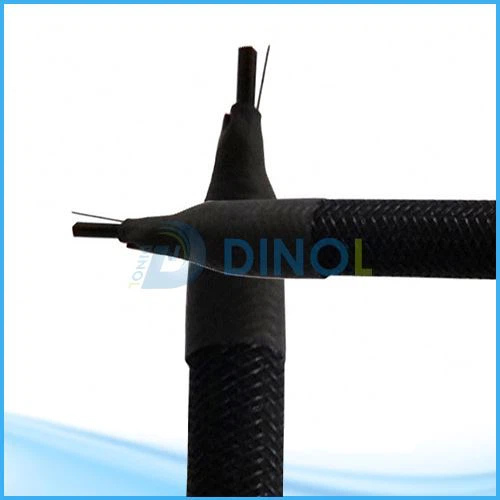
Polymer Flexible Anode
1.Place of Origin:
Shaanxi, China
2.Brand Name:Dinore
3.Model Number:DNPL
4.Application:
Cathodic protection
5.Technique:
Sand blasting Brush Coating
6.Grade:
Titanium
7.Powder Or Not:
Not Powder
8.Ti Content (%):
≥99.95%
9.Current output::
52mA/m, customizable
10.Color:
black
11.Ti content:
99.6%
12.Certificate:
ISO9001
- Fast Delievery
- Quality Assurance
- 24/7 Customer Service
Product Introduction
Conductive Polymer Flexible Anode: Professional Selection & Technical Application Guide
In cathodic protection engineering, flexible anodes are becoming the preferred solution for an increasing number of projects. Unlike conventional point anodes, conductive polymer flexible anodes release protective current in a "linear" manner, delivering a more uniform potential distribution for complex structures such as long-distance pipelines, tank bottom plates, and dense pipe networks.
Product Structure: Cable-Like in Appearance, Entirely Different in Function
Visually, a conductive polymer flexible anode does resemble a power cable. However, its internal structure and functional logic are fundamentally distinct:
Conductor Layer: A stranded copper core serves as the main longitudinal conductive path. The cross-sectional area of the copper core is precisely calculated to ensure extremely low resistive loss over敷设 lengths of several hundred meters, allowing stable current transmission over long distances.
Functional Layer: The copper core is extruded with a conductive polymer material. This is not an ordinary insulating layer but a functional layer with controlled conductivity. It isolates the copper core from the external environment, preventing corrosive media in the soil or water from contacting the copper, while also allowing current to "leak" radially into the surrounding medium at a controlled rate.
Current Release Mechanism: The copper core ensures minimal longitudinal resistance, while the conductive polymer layer provides stable lateral (radial) grounding resistance. Their combined effect means that current in the copper core is not released suddenly from a single point but is instead distributed evenly and slowly along the entire length of the anode, "dripping" into the soil or water. This generates a continuous, uniform electric field around the protected structure.
Simply put: the copper core handles long-distance current transmission; the conductive polymer handles uniform current distribution.
Why Is Coke Backfill Necessary?
When installing a flexible anode, the backfill area typically requires petroleum coke breeze or low-resistivity carbonaceous material. This is not optional but an integral part of the system design:
Reduces Grounding Resistance: The coke layer significantly lowers the contact resistance between the anode and the soil, making it easier for protective current to flow.
Improves the Working Environment: The current density on the conductive polymer surface is further homogenized by the coke layer, preventing localized overload.
Extends Anode Service Life: The coke layer absorbs some electrochemical reaction products and maintains a stable conductive medium around the anode, reducing direct contact between the polymer layer and corrosive ions or high-resistivity soil.
In engineering practice, the thickness, compaction density, and moisture content of the coke layer all affect the overall performance of the anode ground bed.
Application Fields
Conductive polymer flexible anodes are particularly suitable for the following scenarios:
1. Long-Distance Buried Pipelines
With conventional sacrificial anodes or deep well anodes, uneven protection potentials are common along the pipeline. A flexible anode is laid parallel to the pipeline, placing the entire pipeline within the same protective electric field.
2. External Surfaces of Tank Bottom Plates
Tank bottom plates have a large surface area, leading to significant potential differences between the edge and the center. Flexible anodes can be laid around the tank bottom or in multiple parallel rows to address inadequate protection in the central area.
3. Rehabilitation and Capacity Expansion of Existing Pipelines
When retrofitting cathodic protection to existing pipelines, excavation spacing is often limited. Flexible anodes can be installed using directional drilling or shallow trenching alongside the pipeline, eliminating the need for numerous closely spaced vertical wells.
4. Dense Pipe Network Areas (Power Plants, Chemical Plants, Gas Stations)
Underground pipes, grounding grids, and structural foundations intertwine. Point anodes can easily cause interference or shielding. Flexible anodes can be bent as needed to bypass obstacles, achieving conformal protection.
5. High-Resistivity Soil or Freshwater Environments
Conventional anodes have limited current output in such environments. Due to their elongated shape, flexible anodes can achieve sufficient total current output by using an appropriate length.

SPECIFICATIONS
|
Polymer Flexible Anode |
|
|
Current in soil |
52 mA/m (Coke-free anode bed) 82mA/m (With coke anode bed) |
|
Current in water |
10mA/m Pressure (constant water pressure):≤7Mpa |
|
Output Current |
300~1000mAm |
|
Installation and storage temperature (minimum) |
-18℃ |
|
Bending radius |
500mm |
|
Out diameter |
38mm |
|
Weight loss rate of chemical medium immersion test |
3% <1% ASTM D-543 |
|
Weight of the anode |
1.5kg/m |
|
Length per coil |
±500m,1000m(Free cutting length) |
Technical Parameters (Typical Values, Customizable for Projects)
| Parameter | Typical Value |
|---|---|
| Copper Core Cross-Section | 6 mm² / 10 mm² / 16 mm² (selected based on transmission distance) |
| Conductive Polymer Outer Diameter | 10 mm – 16 mm |
| Longitudinal Resistance | ≤ 2.5 Ω/km (depends on copper core specification) |
| Lateral (Radial) Resistance | 0.5 – 5 Ω·m (formulation adjustable for different output needs) |
| Maximum Continuous Operating Temperature | 60°C |
| Maximum Continuous Current Output Density | 5 – 10 mA/m (up to 15 mA/m short-term) |
| Minimum Bend Radius | ≥ 10× outer diameter |
| Supply Length | 200 m / 500 m / 1000 m per reel (joints require specialized techniques) |
| Applicable Ambient Temperature | -20°C to +50°C (installation); -30°C to +60°C (operation) |
| Expected Service Life | 20 – 40 years (depends on coke bed quality and current density) |
Note: The above parameters are based on general designs. Actual selection requires verification based on soil resistivity, required protective current density, and pipeline coating condition.
Key Design and Selection Considerations
Current Output Per Unit Length: Calculate the required linear current density by dividing the total protective current needed for the pipeline or structure by the anode length. Typical range: 3–8 mA/m.
Maximum Installation Length: Limited by the copper core's longitudinal resistance and the remote-end output voltage. Typically, for single-ended power feeding, lengths should not exceed 300–500 meters. Double-ended feeding allows longer lengths.
Coke Bed Dimensions: Standard rectangular trench cross-section: 200 mm × 200 mm to 300 mm × 300 mm. Coke resistivity ≤ 0.5 Ω·m.
Spacing to Pipeline: Typically 0.3–0.5 meters. Smaller spacing may cause localized over-protection; larger spacing increases current loss to the environment.

Frequently Asked Questions (FAQ)
Q1: What is the difference between a flexible anode and a standard power cable?
A: The outer sheath of a power cable is insulating material, designed to prevent current from leaking out. The outer layer of a flexible anode is conductive polymer, specifically designed to release current uniformly. They are not interchangeable.
Q2: Can a flexible anode be installed with bends?
A: Yes. Its structure allows bending, typically with a minimum bend radius of 10 times the outer diameter. This makes it suitable for bypassing obstacles and laying along tank bottom plate edges.
Q3: Is coke backfill absolutely necessary?
A: Highly recommended. Unless the native soil itself has a consistently very low resistivity (<10 Ω·m), a coke layer is critical for ensuring uniform current distribution and maximizing the anode's service life.
Q4: Can a broken or damaged flexible anode be repaired?
A: Yes, using specialized connection kits for field repair. However, it is essential to ensure a reliable connection of the copper core and continuous conductivity of the conductive polymer layer. The repaired joint should be additionally wrapped with coke.
Q5: Can a flexible anode be used with an existing cathodic protection system (e.g., sacrificial anodes or an impressed current rectifier)?
A: Yes. The flexible anode acts as part of the ground bed, powered by the rectifier, replacing conventional ground beds made of high-silicon cast iron or mixed metal oxide anodes. The existing rectifier only needs to have its output capacity verified.
Q6: How can I determine if a flexible anode is still working properly?
A: By measuring the potential of the pipeline/structure against a reference electrode, and measuring the potential gradient along the anode path. Test posts can also be installed at the beginning, middle, and end of the anode to monitor changes in current distribution over time.
Q7: Does installing a flexible anode on an existing pipeline require a shutdown?
A: Generally, no. The flexible anode is laid at a certain distance to the side or below the pipeline using directional drilling or limited excavation methods. However, a specific risk assessment is required for each project plan.
Brief Selection Recommendations
Soil resistivity > 100 Ω·m: Choose a conductive polymer formulation with lower radial resistance and appropriately increase the coke layer thickness.
Protected length > 500 m: Consider double-ended power feeding or increase the copper core cross-section.
High-temperature environments (e.g., near heated pipelines): Verify the softening point and operational stability of the conductive polymer.
Acidic or highly corrosive soils: The coke layer itself is chemically inert, but the connection points require additional sealing.
The core design principle of a flexible anode is not complex: allow the current to "seep out slowly" rather than "release abruptly." This difference directly determines the uniformity of the protective electric field and the real-world service life of the system in complex underground conditions. When selecting, the primary focus should not be on maximizing current output capacity, but on the stability of current distribution and the long-term environmental adaptability of the materials.
Hot Tags: polymer flexible anode, suppliers, manufacturers, factory, customized, buy, price, quality, pricelist, in stock, for sale, flexible anode for marketing strategies, flexible anode for electrical equipment, flexible anode for brand awareness campaigns, flexible anode for coastal facilities, flexible anode for service industry, flexible anode for sales campaigns


