Technological Innovation Drives Performance Breakthroughs in Titanium Anodes
Oct 28, 2025
Technological Innovation Drives Performance Breakthroughs in Titanium Anodes
As the "heart" of the electrochemical industry, the performance of titanium anodes directly determines the efficiency and cost of the entire system. In recent years, with continuous progress in materials science and preparation processes, titanium anodes have achieved significant breakthroughs in catalytic activity, stability, and service life, providing solid technical support for industrial upgrading.
Coating formulation is the key to determining titanium anode performance. The mainstream titanium anode products on the market can be divided into three categories: ruthenium-based coating anodes excel in chlorine evolution reactions, iridium-based coating anodes specialize in oxygen evolution reactions, and platinum-based anodes perform well in special environments. The latest research results show that multi-metal co-doping technology can significantly improve coating performance. For example, a new titanium-based anode prepared by sol-gel method can achieve an overpotential as low as 183mV in specific concentration NaCl solution, and only 257mV in mixed electrolyte. This new electrode can operate stably for 144 hours under industrial-grade current density, laying a technical foundation for large-scale commercial applications.

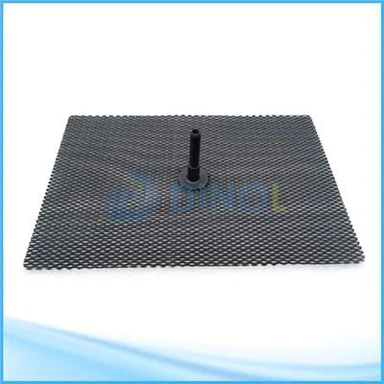
In addition to innovations in material formulations, breakthroughs in structural design are equally remarkable. Traditional flat plate anodes are limited by effective reaction area, while new three-dimensional structure designs achieve qualitative improvements in performance by increasing active area and improving reaction conditions. The newly developed three-dimensional structure titanium anode in the industry uses mesh catalytic electrodes combined with three-dimensional porous materials to construct innovative products with three-dimensional structures. This design significantly improves electrolyte diffusion efficiency, effectively reduces concentration polarization phenomena, while increasing the effective anode area and reducing current density, thereby achieving both energy saving and life extension.
At the manufacturing process level, the industry is also continuously undergoing technological innovation. The latest titanium-based anode processing methods construct substrates with pore structures and use layered preparation technology to complete coating preparation layer by layer. This process not only enhances the anode's corrosion resistance, enabling it to adapt to more complex working conditions, but also optimizes coating materials and structure, significantly improving current efficiency and conductive performance.
Compared with traditional graphite electrodes and lead-based alloy electrodes, titanium anodes demonstrate comprehensive performance advantages: better electrode dimensional stability ensures constant interelectrode distance during electrolysis; lower working voltage can reduce DC power consumption by 10%-20%; significantly extended service life - in the chlor-alkali industry, titanium anodes can last for more than 6 years, while graphite anodes can only be used for 8 months; excellent corrosion resistance effectively avoids contamination of electrolyte and cathode products.
With the continuously increasing requirements for electrode performance in industrial applications, titanium anode technology is developing rapidly towards high efficiency, long life, and wide adaptability. Multi-component composite coatings and refined structural design have become the main battlefield of industry technology competition.
https://dinoer-anodes.com
Email:dinore@di-nol.com
Whatsapp:+86 138 9245 5776