Titanium Anode Selection Guide: Master Coating, Working Condition and Service Life to Avoid Pitfalls
Sep 14, 2026
Titanium Anode Selection Guide: Master Coating, Working Condition and Service Life to Avoid Pitfalls
Professionals engaged in electrolytic water treatment, electroplating, chlor-alkali chemical industry and cathodic protection have most likely encountered problems with improper titanium anode selection. Many purchasers only focus on unit price, assuming that products with similar appearance and marked parameters are identical and choosing the cheapest option is cost-effective. However, after formal operation, problems such as coating peeling, sharp efficiency decline and equipment shutdown often occur within just a few months. The core reason lies in the mismatch between titanium anode coatings and actual working conditions.
The titanium anode widely used in the industry is professionally named DSA (Dimensionally Stable Anode), also known as MMO (Mixed Metal Oxide) coated titanium anode. It adopts TA1 and TA2 industrial pure titanium as the substrate, with a high-temperature sintered precious metal catalytic coating on the surface. There is a common misunderstanding that the titanium substrate determines the service life. In fact, the precious metal coating is the key factor that affects the electrode efficiency, corrosion resistance and overall service life. A well-matched coating ensures a service life of several years, while an inappropriate coating will fail quickly even with a thick titanium substrate under complex working conditions.

Difference Between Two Mainstream Industrial Titanium Anodes: Ruthenium-Iridium vs Iridium-Tantalum
Over 90% of industrial applications adopt two types of coated titanium anodes: ruthenium-iridium coating and iridium-tantalum coating. The two products look almost the same in appearance but are completely different in applicable scenarios. Mixing or misusing them will lead to accelerated scrapping.
1. Ruthenium-Iridium Titanium Anode (For Chlorine Evolution Environment)
It is a dedicated and widely used anode for working conditions with high chloride ion content. It is the optimal choice for sodium hypochlorite generators, seawater desalination, ballast water treatment, swimming pool water disinfection and chlor-alkali brine electrolysis.
It features low chlorine evolution potential, high current utilization rate and stable operation, delivering excellent cost performance for mass production in terms of procurement and long-term operating costs.
Critical Note: Do not use it in strong oxygen evolution and acidic working conditions. In sulfuric acid systems and high-oxidation acid wastewater environments, the coating of ruthenium-iridium anodes will be rapidly corroded, resulting in a greatly shortened service life and frequent replacement costs.
2. Iridium-Tantalum Titanium Anode (For Strong Acid & Oxygen Evolution Environment)
Iridium-tantalum coated anodes are the preferred choice for high-difficulty industrial wastewater treatment, electrolytic copper foil production, PCB electroplating, hydrometallurgy and metal electrowinning. These working conditions are characterized by strong acidic media, high current density and continuous oxygen evolution reaction, which require electrodes with superior corrosion resistance.
This type of titanium anode boasts outstanding resistance to strong acid and oxidation, excellent adaptability to harsh working conditions, and stable electrolysis efficiency under long-term continuous power-on operation, making it the first choice for complex industrial wastewater treatment projects.
Industry-proven selection rule: Ruthenium-iridium anodes for chloride-containing water, and iridium-tantalum anodes for strong acid wastewater.
3. Platinum-Plated Titanium Anode (High-End Niche Application)
It is not used for industrial mass production. It is mainly applied in precision electroplating, laboratory electrochemical experiments and high-end precious metal electrolysis scenarios. Though it has extremely high chemical stability, its high cost makes it unsuitable for large-scale engineering projects and conventional industrial applications.
Why Industrial Fields Are Switching to Titanium Anodes: Obvious Advantages Over Traditional Anodes
Graphite anodes and lead anodes, which were widely used in factories in the early stage, have obvious defects including fast wear and poor stability. They continuously dissolve and deform during operation, not only consuming consumables rapidly but also polluting the electrolyte. Frequent shutdowns for replacement seriously hinder production progress.
MMO coated titanium anodes perfectly solve the above problems:
Firstly, they feature stable dimensional performance without dissolution or deformation during power-on operation, maintaining a constant electrode distance and stable cell voltage to avoid fluctuating production conditions. Secondly, the precious metal coating reduces the electrolytic reaction potential, bringing remarkable power-saving effects for long-term mass production. Thirdly, they have a long service life of several years under standard working conditions. Moreover, the titanium substrate can be recoated after removing the old coating, avoiding repeated purchase of new substrates and greatly reducing long-term operation and maintenance costs.
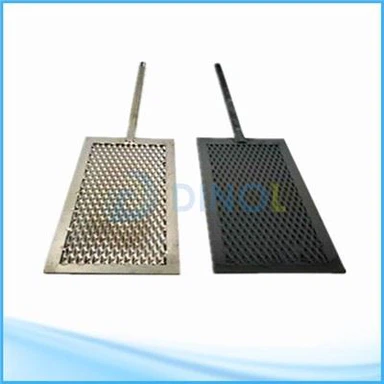
In addition, titanium anodes support highly customized processing, available in mesh, plate, rod, cylinder and strip shapes to match various equipment and working condition requirements.
Key Working Condition Taboos: Main Causes of Titanium Anode Damage
Though titanium anodes have excellent corrosion resistance and stability, they are not universally applicable. Many manufacturers fail to inform users of usage restrictions, leading to unnecessary losses.
Fluoride ions and high-concentration cyanide ions are the main corrosive factors for titanium anodes, which will directly erode the titanium substrate, causing coating peeling and complete electrode scrapping. In addition, reverse current, excessive current density, long-term high-temperature electrolyte and continuous sediment friction will accelerate coating wear and shorten the service life significantly.
Therefore, product selection must be matched with on-site working parameters to avoid taboo scenarios.
Core Application Scenarios of Titanium Anodes
Titanium anodes are applicable to most industrial electrochemical fields, with mainstream applications as follows:
1. Environmental Water Treatment: Refractory industrial wastewater, landfill leachate, circulating water scale removal, electrocatalytic oxidation, electrolytic disinfection and sterilization;
2. Chlor-Alkali Chemical Industry: Brine electrolysis, sodium hypochlorite generation equipment, seawater treatment, swimming pool water treatment and ballast water treatment;
3. Electroplating and Metallurgy: PCB electroplating, electrolytic copper foil, hydrometallurgical extraction and precious metal electrowinning;
4. Cathodic Protection: Impressed current cathodic protection for oil and gas pipelines, storage tanks and wharf steel structures;
5. New Energy Storage: Flow batteries and supporting electrodes for industrial hydrogen production via electrolysis.
Purchasing Experience & Avoidable Pitfalls
Years of industry experience has witnessed many failure cases caused by low-price procurement. It is not advisable to judge titanium anodes merely by unit price. Products with identical appearance vary greatly in coating formula, sintering process and substrate purity, which cannot be distinguished by inexperienced purchasers.
First, prioritize working condition matching. Confirm whether the medium contains chloride or strong acid, and select ruthenium-iridium or iridium-tantalum coating accordingly.
Second, require manufacturers to provide substrate material certificates, coating process parameters and service life test reports, and avoid unqualified OEM products.
Third, clarify on-site parameters in advance, including electrolyte composition, operating temperature, current density and continuous/intermittent power-on mode. Accurate parameters ensure stable service life of customized anodes.
Fourth, for complex high-difficulty wastewater and special working conditions, conduct small-scale tests first to verify stability and service life before bulk procurement, so as to avoid large economic losses.
Domestic titanium anode technology has become mature after years of iteration. The coating technology, processing accuracy and delivery efficiency of domestic source factories are comparable to imported products with higher cost performance. The core of industrial selection is not to pursue the most expensive product, but to select the most suitable one for specific working conditions, reduce production loss and operation costs, and achieve long-term economic benefits.