Probe Anode Through-Wall Installation: The Cable Seal Dies Before the Coating Does
Oct 21, 2026

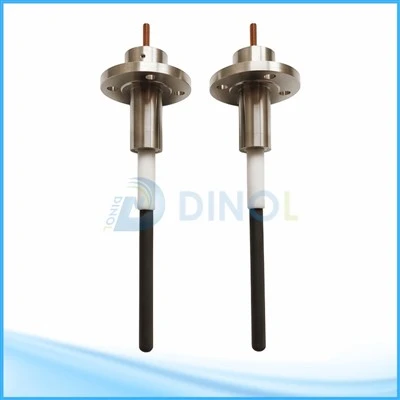
A probe anode looks simple. Titanium rod, MMO coating on the tip, bare shaft in the middle, cable at the back. Push it through a nozzle on a water box or a pressure vessel, tighten the flange, connect the rectifier, done.
Then six months later the potential reading drifts, the rectifier current climbs, and someone pulls the probe out. The coating still carries current. The titanium substrate is not pitted. The cable joint is wet inside.
This is not a rare story. On internal ICCP probes, the anode-to-cable transition fails more often than the mixed metal oxide layer does. The anode is inert and dimensionally stable. The joint sits where copper, titanium, polymer and water meet - and that is where most field problems start.
The conductor is crimped or welded to the titanium rod. A single layer of heat-shrink tubing is not a seal. Adhesive-lined heat shrink helps, but under temperature cycling and hydrostatic pressure it can creep and let moisture track inward. A resin or epoxy canister around the crimp zone is the usual minimum for buried, submerged or pressurized service. The canister has to be poured without trapped air, chemically compatible with the medium, and the cable needs strain relief so thermal movement does not loosen the compression point.
Good shops do not stop at "looks sealed." They check insulation resistance, do a pull test on the termination, and pressure-test the joint in water at or above the working hydrostatic pressure before shipment. A joint that passes the bench test does not guarantee twenty years. A joint that fails on the bench guarantees a field failure.
The second problem is isolation length. The active MMO section must end far enough from the wall penetration that the steel shell never sees anode potential. If the coating runs too close to the flange, the shell can polarize, the decoupler can track, and the vessel itself starts acting like part of the anode circuit. For ship hull penetrations, classification practice is stricter: a cofferdam or double-gland assembly is used so the cable passes through the hull without making the steel structure an extension of the anode.
How far is "far enough" has no single number. It depends on wall thickness, operating voltage, medium resistivity, and whether the penetration is plastic-lined, flanged or hot-tapped. Seawater at higher voltage needs more clearance than fresh water at low voltage. If the decoupler sleeve is too short, fit a longer one. If the nozzle lands too close to the active section, specify a longer probe. These are mechanical details, but they decide whether the system protects the equipment or quietly damages it.
The third issue nobody puts on the datasheet: flow-induced motion. A slim cantilevered rod hanging into a water box with fast cross-flow is a beam in a fluid stream. Vortex shedding, turbulent buffeting and fluidelastic effects can excite it. Whether it actually fatigues depends on unsupported length, rod diameter, end condition, natural frequency and flow velocity - not on the coating formula. In a shell-and-tube exchanger the same physics wrecks tubes at the baffle supports; a probe rod is just a shorter, fatter version of the same problem. The fix is not "use better MMO." The fix is a support collar, larger diameter, shorter cantilever, or a stiffener that keeps the natural frequency away from the shedding frequency.
When a buyer asks how long the probe lasts, the coating is the wrong place to start. Ir-Ta in fresh water, Ru-Ir in seawater - both have very low consumption: roughly 0.5–1 mg/A·yr in seawater chlorine-evolution service, around 6 mg/A·yr in freshwater/soil oxygen-evolution service. The cable seal either holds or it does not. The decoupler either isolates or it does not. The cantilever either clears the flow or it does not. Internal-probe life is decided by the assembly, not by the precious-metal oxides.
A probe anode is not a metal stick with a wire. It is a penetration assembly: titanium substrate, catalytic coating, isolation sleeve, sealed cable termination, flange or nozzle, and the flow field around the rod. The coating is the last thing to fail. Everything around it fails first.
Specifying a probe for a water box, heat exchanger or process vessel means sending the nozzle drawing, wall thickness, operating pressure, medium, chloride level, flow velocity and cable length. State whether the install is hot-tap or cold. Say the target steel potential and the reference electrode type. "MMO probe, 19 mm, 300 mm" is not an order. It is a guess with a diameter.