After the Flexible Anode Goes in the Trench
Nov 18, 2026

Dr. Emily Carter
As a senior research scientist at Di Noer Technology, Dr. Carter specializes in the development of MMO noble metal mixed oxide coated titanium anodes. With over 15 years of experience in electrochemical materials, she leads the R&D team in creating innovative solutions for water treatment and energy storage industries.
The back-and-forth before an order is usually about the anode itself - wire diameter, internal cable, coating, finished OD. Once the crates reach site, what decides whether the current spreads is a different set of things: how the trench is cut, what goes back in it, how far off the pipe the anode sits. Rectifier positive to anode, negative to pipeline, and the stretch in between has to be travelled through soil. The soil is the electrolyte. The anode is only where the current gets in.
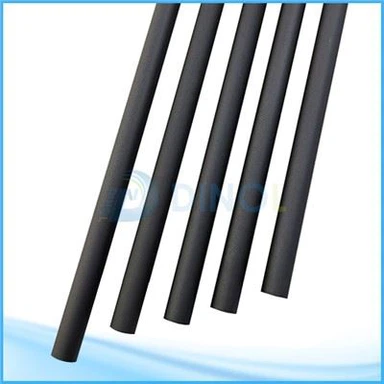
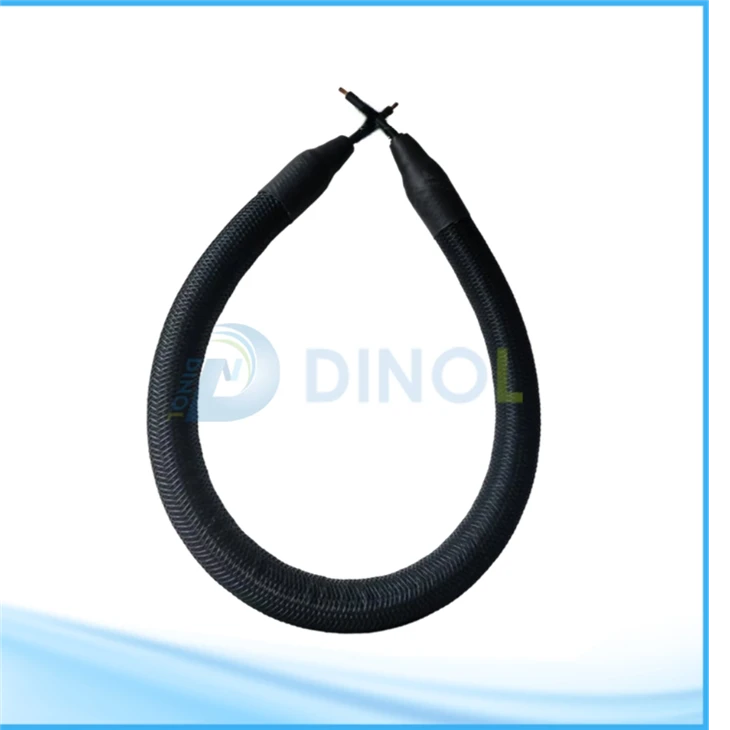
Two constructions share the name and sit an order of magnitude apart, so it helps to say which one is on the table. The MMO/Ti wire type runs a Grade 1 titanium wire with an Ir-Ta coating, a parallel copper core carrying current down the length, connection points roughly every 3 m, and an outer build of calcined petroleum coke, acid-resistant fabric and abrasion braid - typically 300–1000 mA/m in soil. The conductive-polymer type extrudes a modified conductive polymer over stranded copper and lets the polymer do the discharging: 52–82 mA/m, an upper current density around 100 A/m² with carbonaceous backfill, polymer consumption 0.2–0.9 kg/A·yr. The figures on our product page belong to the first type: MMO/Ti wire at Φ1.0, Φ1.5, Φ2.0 and Φ3.0 mm with Φ3.0 recommended, standard internal cable 1×10 mm² and customizable, finished nominal OD Φ39.5 mm with +0.5 mm tolerance, so 39.5–40.0 mm as delivered. Those are order-form columns, not the output of a design calculation.
The coke is part of the bed, not the packing
Inside that 39.5 mm, the coke powder is doing two jobs. It enlarges the effective discharging surface, which pulls anode-to-earth resistance down, and it gives the oxidation reactions somewhere to happen other than the anode core. General coke breeze runs about 35 Ω·cm, calcined petroleum coke 10–15 Ω·cm, the family roughly 10–50 Ω·cm - provided it is tamped and in contact. The 10–15 cm layer laid in the trench bottom, with the anode flat against it, is the same idea. If the fabric jacket gets torn and coke leaks, seal it before laying, or the current will bunch at that one spot. Miss a length of backfill, let stones into it, leave the anode suspended or folded, and uniform line discharge collapses back to a few points doing all the work. Jacket condition is one of the things the dispatch bay glances at when it checks the papers against the crate; it doesn't get a separate report.
Resistivity raises the driving voltage
High resistivity is the input most often under-weighted. Past roughly 10,000 Ω·cm, circuit resistance climbs, the rectifier has to push harder, current prefers to stay near the bed, and the remote pipe ends up under-protected while the soil IR drop makes ON potentials look more negative than the polarized state really is. Rocky sections, desert, a dry season that takes the moisture out - all of it lands here. Readings an order of magnitude apart a few hundred metres along one line are unremarkable, so a design built on a single measurement by the rectifier site tends to show its weak stretch when the ground dries.
The criterion moves with it. The usual basis is a polarized potential at or beyond −850 mV versus CSE with IR drop taken out; −750 mV may be used at 100–1000 Ω·m, −650 mV above 1000 Ω·m, −950 mV where bacterial corrosion is in play. ON and instant-off belong in separate columns on the record. A bare "−850, passes" with no reference electrode and no measurement state cannot be checked later. High-resistivity soil and desert appear on the product page for this reason, not because the anode survives dry ground better - continuous discharge along the route simply runs into less remote under-protection and shielding than a single deep-well bed does.
Where 0.3–1 m comes from
Parallel spacing is a compromise, not a slogan. Too close and local over-protection or shielding turns up; too far and remote current density falls away. On site the run generally goes no nearer than 300 mm and no nearer than half the pipe diameter, level with the pipe bottom, laid slack with 2–5% extra for settlement, never dragged, bend radius kept as a multiple of the OD. Long-distance lines commonly sit at 0.5–1.0 m; payout tension, minimum bend radius and how much of the anode actually touches the coke layer are all things the pre-install check goes back over. Concentric rings or grids under a tank bottom follow the same logic - spacing, sand resistivity and burial depth set the potential distribution together, and the 1.5 m that looked even in one simulation belonged to that sand and that depth, not to every site. Spiral wrapping, the other method on the page, has a different aim: local repair on old lines, elbows, crossings, clusters of coating damage, where the point is to concentrate output on one section rather than spread it along the whole route.
Long runs are fed in segments. Around stations the common limit is 300 m per segment with its own cathode return, and crossings get insulating sleeves so the anode never touches buried metal. A test post reads pipe-to-soil potential; the rectifier reads total output. Neither proves every metre passes, so test-point spacing, coating condition, shielding and continuity have to be read together. Material, line and size make up an inspection lot - often capped at 5000 m - checked for appearance, OD and linear mass, with the MMO/Ti wire accelerated life report supplied against it, TM0108 or ISO 19097-2 as the case may be. Why those hours do not convert into field years is covered in a separate note on this site, and doesn't need repeating here.
Reading the "50 years" figure
The product page quotes up to 50 years for MMO-coated flexible anodes. Elsewhere you will find around 25 years, and "more than 40 years when correctly installed and kept inside its current-density limit" - each of them tied to discharge density, soil chemistry, temperature and medium. They are not competing claims so much as the same anode attached to different duties. The form that survives a specification review is a range with its conditions attached: at this resistivity, this discharge density, this backfill state, against this criterion, expect this many years. A year count standing alone stops meaning much once the site changes.
So when the question is how long, how deep and how far off the pipe, the first things to ask for are not on the spec sheet. They are resistivity along the route including the dry-season worst case, coating quality and where the coating has broken down, the backfill and laying method, and where the segments and test points sit. Wire diameter, core section and finished OD are the columns you fill in last. Get the trench right and the numbers on the spec sheet have somewhere to go.
Have resistivity, coating data and a laying method for a live project? Send them over and we'll check the basis together.