

How to select the appropriate MMO Titanium Anode Wire for different current waveforms?
Jun 16, 2025
Hey there! As a supplier of MMO Titanium Anode Wire, I've seen firsthand how crucial it is to pick the right anode wire for different current waveforms. In this blog, I'll share some tips on how to make that selection.
Understanding Current Waveforms
Before we dive into choosing the appropriate MMO Titanium Anode Wire, let's quickly go over different current waveforms. There are mainly three types: direct current (DC), alternating current (AC), and pulsed current.
DC is a constant flow of electric charge in one direction. It's commonly used in applications like cathodic protection systems for pipelines and storage tanks. AC, on the other hand, changes its direction periodically. It's widely used in electrical power distribution. Pulsed current is a series of short-duration current pulses. This waveform is often used in electroplating and some specific industrial processes.
Selecting MMO Titanium Anode Wire for DC Waveforms
When dealing with DC waveforms, the key factors to consider are the current density and the environment where the anode will be used.
Current Density
The current density is the amount of current flowing through a unit area of the anode. For DC applications, a lower current density generally leads to a longer anode life. If you're using the MMO Titanium Anode Wire in a cathodic protection system, you need to calculate the required current based on the size of the structure to be protected and the soil or water resistivity.
Let's say you're protecting a small pipeline. You'll need to determine the surface area of the pipeline and then calculate the appropriate current density. Based on that, you can choose the right diameter and length of the MMO Titanium Anode Wire. A thicker wire can handle higher currents, but it might be more expensive. So, you need to find a balance between cost and performance.
Environment
The environment also plays a big role. If the anode is going to be used in a corrosive environment, like seawater or acidic soil, you need to choose an anode with a suitable coating. The MMO coating on the titanium wire is designed to resist corrosion, but different coatings have different levels of resistance. For seawater applications, a coating with high chlorine evolution efficiency is often preferred.
The MMO Titanium Wire Anode for Cathodic Protection is specifically designed for DC cathodic protection systems. It has a stable performance in various environments and can provide long-term protection for your structures.
Selecting MMO Titanium Anode Wire for AC Waveforms
AC waveforms bring some different challenges compared to DC.
Frequency
The frequency of the AC waveform is an important factor. Higher frequencies can cause more rapid wear and tear on the anode. For low-frequency AC applications, the same principles as DC selection apply to some extent. However, for high-frequency AC, you need to consider the skin effect.
The skin effect causes the current to flow mainly on the surface of the conductor at high frequencies. This means that the effective cross-sectional area of the wire for current flow is reduced. To compensate for this, you might need to choose a wire with a larger surface area or use multiple smaller wires in parallel.
Reactance
Another consideration is the reactance of the anode. Reactance is the opposition to the flow of alternating current due to inductance and capacitance. You need to choose an anode wire with low reactance to ensure efficient current flow. Some MMO Titanium Anode Wires are designed to have low reactance, which makes them suitable for AC applications.

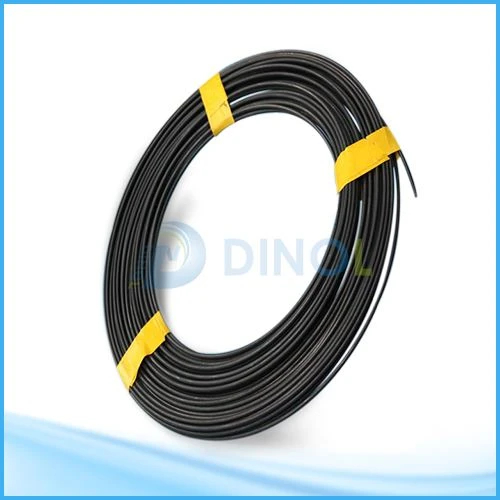
The MMO Titanium Wire Anode for Industrial Use can be a good choice for AC industrial applications. It can handle a wide range of frequencies and has good electrical properties.
Selecting MMO Titanium Anode Wire for Pulsed Current Waveforms
Pulsed current waveforms are a bit more complex because of the short-duration high-current pulses.
Pulse Duration and Frequency
The pulse duration and frequency are critical. Short-duration, high-frequency pulses can generate a lot of heat in the anode. You need to choose an anode wire that can dissipate this heat effectively. A wire with a larger surface area or a good thermal conductivity is preferred.
Peak Current
The peak current during the pulse is also important. The anode needs to be able to handle this high current without being damaged. You might need to select a wire with a higher current-carrying capacity or use multiple wires in parallel to share the load.
Other Considerations
Cost
Cost is always a factor. While you want to choose the best anode wire for your application, you also need to stay within your budget. Sometimes, a slightly less expensive option might still meet your requirements. You can compare different products and suppliers to find the best value for money.
Installation and Maintenance
Consider the ease of installation and maintenance. Some anode wires are easier to install, which can save you time and labor costs. Also, think about how easy it will be to replace the anode when it reaches the end of its life.
Conclusion
Selecting the appropriate MMO Titanium Anode Wire for different current waveforms is a multi-faceted process. You need to consider the current waveform type, current density, environment, frequency, pulse characteristics, cost, and installation and maintenance requirements.
If you're still unsure about which MMO Titanium Anode Wire is right for your application, don't hesitate to reach out. We're here to help you make the best choice. Whether you're working on a cathodic protection project or an industrial electroplating process, we have the expertise and products to meet your needs. Contact us today to start the procurement process and let's work together to find the perfect solution for your project.
References
- Electrochemical Engineering Principles, by John Newman and Karen E. Thomas-Alyea
- Cathodic Protection Handbook, by Craig L. Dunn